
International Morse Code Translator: The World's Standard in Dots & Dashes
One alphabet, understood by radio operators in Tokyo, pilots over the Atlantic and sailors off Cape Town. This translator follows the official International Morse code standard, so every letter you encode reads the same anywhere on the planet.
One alphabet, understood by radio operators in Tokyo, pilots over the Atlantic and sailors off Cape Town. This translator follows the official International Morse code standard, so every letter you encode reads the same anywhere on the planet.
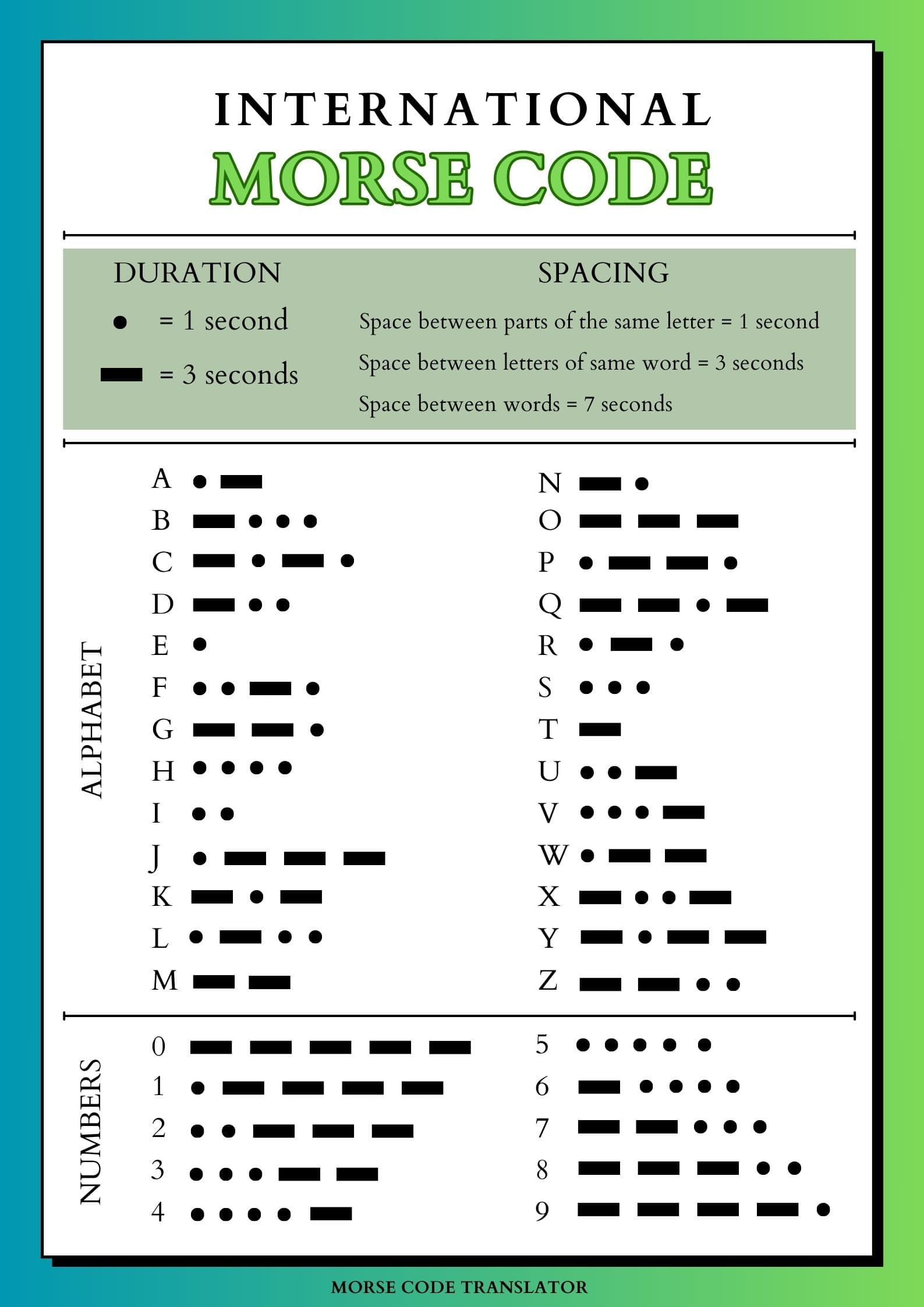
Translate Text to International Morse Code and Back
Type any message and it converts to International Morse code as you write. Paste dots and dashes and the decoder turns them back into plain text just as fast.
Use a dot (.) for a short signal and a dash (-) for a long one. Leave one space between letters and a slash (/) between words, so -.-. --.- reads as CQ and .... .. / .- .-.. .-.. reads as HI ALL.
Press play to hear your message as clean radio-style beeps, or switch to visual mode and watch it flash. You can copy the result, download the audio, or share it with someone who has to crack it by ear.
What Makes Morse Code "International"?
The code Samuel Morse and Alfred Vail built in the 1840s worked well on American telegraph lines, but it used awkward internal gaps and several dash lengths. In 1848, German engineer Friedrich Clemens Gerke simplified it into a cleaner system of just dots and dashes.
Gerke's version spread across Europe's telegraph networks. In 1865, the International Telegraph Conference in Paris adopted it as the common standard, and it became known as International Morse code.
Today the standard is maintained by the International Telecommunication Union in recommendation ITU-R M.1677-1. Its most recent addition is the @ sign (.--.-.), added in 2004 so email addresses could travel by Morse too.
International Morse Code Chart: Letters, Numbers & Punctuation
Every character has a fixed pattern. The most frequent letters get the shortest codes, so E is a single dot and T a single dash, while rarer letters like Q and Y take four signals.
| Letter | Morse | Letter | Morse | Number | Morse |
|---|---|---|---|---|---|
| A | .- | N | -. | 1 | .---- |
| B | -... | O | --- | 2 | ..--- |
| C | -.-. | P | .--. | 3 | ...-- |
| D | -.. | Q | --.- | 4 | ....- |
| E | . | R | .-. | 5 | ..... |
| F | ..-. | S | ... | 6 | -.... |
| G | --. | T | - | 7 | --... |
| H | .... | U | ..- | 8 | ---.. |
| I | .. | V | ...- | 9 | ----. |
| J | .--- | W | .-- | 0 | ----- |
| K | -.- | X | -..- | ||
| L | .-.. | Y | -.-- | ||
| M | -- | Z | --.. |
| Punctuation | Morse | Punctuation | Morse |
|---|---|---|---|
| Period (.) | .-.-.- | Slash (/) | -..-. |
| Comma (,) | --..-- | Equals (=) | -...- |
| Question mark (?) | ..--.. | Plus (+) | .-.-. |
| Apostrophe (') | .----. | Hyphen (-) | -....- |
| Colon (:) | ---... | Quotation mark (") | .-..-. |
| Open bracket ( ( ) | -.--. | Close bracket ( ) ) | -.--.- |
| At sign (@) | .--.-. |
Notice the numbers: each one is exactly five signals, counting up in dots and down in dashes. Learn 1 and 6 and you can work out the rest. For printable versions, see the Morse code alphabet, numbers and punctuation guides.
Timing and Prosigns: The Rules Every Operator Follows
International Morse code is measured in units, not seconds. That's what lets a slow learner and a 40-words-per-minute expert speak the same language.
-
A dot lasts 1 unit; a dash lasts 3 units.
-
The gap between signals inside a letter is 1 unit.
-
The gap between letters is 3 units.
-
The gap between words is 7 units.
Operators also use procedural signals to manage a conversation. Many are prosigns: two letters sent as one run with no gap between them.
| Signal | Morse | Meaning |
|---|---|---|
| SOS | ...---... | Distress — help needed |
| CQ | -.-. --.- | Calling any station |
| AR | .-.-. | End of message |
| SK | ...-.- | End of contact |
| BT | -...- | Break / new section |
| KN | -.--. | Go ahead, named station only |
| Error | ........ | Mistake — resend from last word |
International vs American Morse Code
American Morse code is the original 1840s telegraph version. It survived on US railroads into the 20th century but is rarely heard today outside historical demonstrations.
International Morse code replaced it almost everywhere because it is simpler to send and harder to misread. The biggest differences:
-
Spacing inside letters: American Morse uses internal gaps in letters like C, O, R, Y and Z. International Morse never does.
-
Dash lengths: American Morse has longer dashes for L and the number 0. International Morse uses one dash length.
-
Different patterns: many letters and most numbers are coded differently, so a message sent in one system decodes as nonsense in the other.
-
Where it's used: International Morse is the standard for amateur radio, aviation beacon identifiers and emergency signalling. American Morse is mostly heritage telegraphy.
Working with a vintage telegraph message? Switch to the American Morse code translator instead.
FAQs
1. What is International Morse code?
International Morse code is the global standard version of Morse code, using dots and dashes to represent letters, numbers and punctuation. It was adopted in 1865 and is the version used in amateur radio and aviation today.
2. Who sets the International Morse code standard?
The International Telecommunication Union (ITU) maintains it. The current definition is recommendation ITU-R M.1677-1, which lists every character, the timing rules and the standard procedural signals.
3. How is International Morse code different from American Morse code?
International Morse code uses only dots and one length of dash, with no gaps inside letters. American Morse code, the original telegraph version, has internal spaces and longer dashes, and many characters are coded differently.
4. Is Morse code the same in every country?
For the Latin alphabet, yes — A is .- everywhere. Languages with other scripts, such as Cyrillic, Greek, Arabic, Hebrew and Japanese, use their own extensions built on the same dot-and-dash timing.
5. Does International Morse code have an exclamation mark?
Not officially. The ITU standard has no exclamation mark, but many operators and translators use -.-.-- for it. If you need a message to be strictly standard, spell it out or leave it off.
6. How fast is International Morse code sent?
Speed is measured in words per minute (WPM), using the word PARIS as the standard length. Beginners usually learn at 5–15 WPM, while experienced radio operators often copy 20–30 WPM or more.
7. What is SOS in International Morse code?
SOS is ...---... — three dots, three dashes, three dots — sent as one continuous signal rather than three separate letters. It has been the international distress call since 1908.
8. Is International Morse code still used today?
Yes. Amateur radio operators use it daily, and aviation navigation beacons identify themselves with it. Ships stopped relying on it for official distress traffic in 1999, but SOS remains universally recognized by light, sound or tap.